
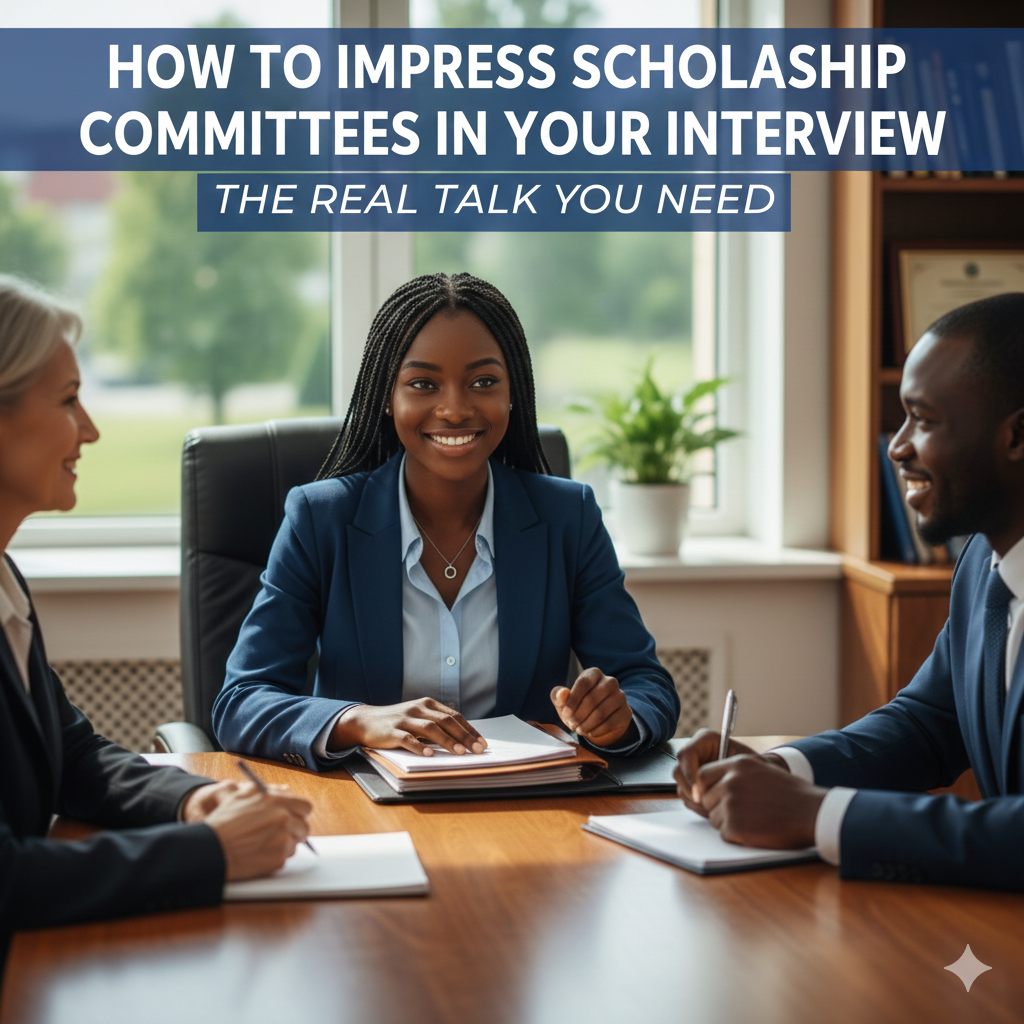
You know that feeling when you’re standing outside the interview room, palms sweating, mentally rehearsing your achievements like they’re lines in a high-stakes Broadway production? Yeah, I’ve been there. And let me tell you something—scholarship committees can smell rehearsed desperation from a mile away.
Here’s the truth: impressing a scholarship committee isn’t about transforming into some perfect, robotic version of yourself. It’s about showing up as the most authentic, prepared, and compelling version of who you already are. Think of it less as a performance and more as a conversation where you get to tell your story to people who genuinely want to invest in your future.
Over the years, I’ve talked to dozens of scholarship recipients, sat on panels, and watched countless students nail their interviews (and some spectacularly bomb them). What I’ve learned is that the difference between “thanks for coming” and “congratulations, you’re our top choice” often comes down to a handful of surprisingly simple strategies that most people overlook.
So let’s cut through the noise and get to what actually works.
Understanding What Scholarship Committees Really Want
Before we dive into specific scholarship interview tips, let’s talk about what’s happening on the other side of that table. Committee members aren’t looking for perfection—they’re looking for potential. They want to know if their money will be well-invested in someone who’ll make a difference.
Think about it from their perspective: they’re not just funding your education; they’re betting on your future impact. They’re asking themselves questions like “Will this person follow through?” and “Does this applicant’s values align with our mission?” and honestly, “Is this someone we’d enjoy supporting for the next four years?”
Understanding this shift in perspective changes everything about how to prepare for scholarship interview situations. You’re not just answering questions—you’re building a relationship.
What Should I Wear to a Scholarship Interview?
Let’s start with the obvious elephant in the room: scholarship interview attire. I know, I know—it seems superficial to worry about clothes when your ideas and achievements should speak for themselves. But here’s the reality: first impressions are formed in about seven seconds, and your appearance is a huge part of that initial read.
The golden rule? Dress one level more formal than you think necessary.
For most scholarship interviews, this means:
-
- Men: A well-fitted suit or dress pants with a button-down shirt and tie. Keep colors neutral—navy, charcoal, or black. Your shoes should be polished (seriously, they notice).
-
- Women: A conservative suit, professional dress, or blouse with dress pants or a skirt. Aim for knee-length or longer if wearing a skirt or dress. Closed-toe shoes are your safest bet.
Here’s what I’ve observed: when you’re slightly overdressed, you show respect for the opportunity and the committee’s time. When you’re underdressed, you’re starting from behind before you even open your mouth.
A quick wardrobe checklist:
-
- Fit matters more than brand: Ill-fitting expensive clothes look worse than well-fitted budget options
-
- Keep accessories minimal: One watch, simple jewelry, nothing distracting
-
- Grooming counts: Clean nails, neat hair, subtle cologne/perfume if any
-
- Bring a professional bag or folder: Carrying your materials in a backpack sends the wrong message

Image of professional interview attire examples
How to Answer “Why Do You Deserve This Scholarship?”
Ah, the question that makes even the most confident students squirm. It feels arrogant to talk about why you “deserve” something, right? But here’s the reframe that changed my perspective: they’re not asking you to justify your worthiness as a human being. They’re asking you to articulate the alignment between your goals and their mission.
The anatomy of a killer answer:
-
- Start with genuine gratitude: “I’m honored to be considered for this scholarship because…”
-
- Connect their mission to your story: Show you’ve done your homework about what they value
-
- Highlight specific achievements that align: Not a laundry list—just 2-3 concrete examples
-
- Paint a picture of future impact: What will you do with this opportunity that serves their goals?
Here’s an example that works:
“I’m incredibly grateful for this opportunity because the Johnson Scholarship’s commitment to environmental advocacy aligns perfectly with my work. Over the past two years, I’ve led a campus initiative that reduced our dining hall waste by 40%, which taught me that systemic change happens when you combine data with community engagement. This scholarship would allow me to pursue my environmental engineering degree without working three part-time jobs, giving me time to expand this model to other schools. I want to deserve this investment by creating scalable solutions that other students can implement.”
See what happened there? Gratitude, alignment, evidence, and forward-looking impact. No awkward “I deserve this because I work hard” generalities.
Common mistakes to avoid:
-
- Comparing yourself to other applicants (“I’m more qualified than most students”)
-
- Focusing solely on financial need without connecting to merit or mission
-
- Being too humble and underselling your achievements
-
- Making it all about what you’ll get rather than what you’ll give
Mastering Common Scholarship Interview Questions
Let’s tackle the bread and butter—those common scholarship interview questions you know are coming. The secret? These aren’t trick questions. They’re invitations to tell your story strategically.
“Tell Me About Yourself”
This seemingly simple opener trips up so many people. You’re not writing your autobiography here. Think of this as your movie trailer—a compelling 90-second preview that makes them want to know more.
My formula for the perfect “tell me about yourself” scholarship response:
-
- Present (15 seconds): “I’m currently a junior at State University studying biochemistry…”
-
- Past (30 seconds): “My interest started when my grandmother was diagnosed with Alzheimer’s, which led me to volunteer at a memory care facility and eventually start researching neurodegenerative diseases…”
-
- Future (30 seconds): “After graduation, I plan to pursue my PhD and ultimately contribute to therapeutic interventions that can extend quality of life for patients like my grandmother…”
-
- Why this scholarship (15 seconds): “This scholarship represents more than financial support—it’s validation that the work I’m doing matters, and it would allow me to dedicate my summer to research rather than working retail.”
Notice how it’s chronological, connected, and purposeful? That’s the flow you want.
"What Are Your Strengths and Weaknesses?"
Ugh, this question. But here’s the thing—scholarship committees aren’t trying to catch you in a humble-brag or watch you squirm. They want to see self-awareness and growth mindset.
For strengths:
Choose 2-3 that are relevant and supported by evidence. “I’m organized” means nothing without the story about how you coordinated a 200-person campus event or maintained a 4.0 while working 25 hours weekly.
For weaknesses:
Pick something real (they can smell BS), but not disqualifying, and always pair it with what you’re doing about it.
“I used to struggle with public speaking—like, heart-racing, voice-shaking struggle. But I knew it was holding me back, so I joined Toastmasters and forced myself to present at every lab meeting. I’m still not a natural, but I’ve learned that preparation beats talent, and now I actually volunteer to present our team’s research.”
That’s the pattern: real weakness + proactive growth + current status.
Comparison table of good vs. bad weakness answers
| Weak Answer | Strong Answer |
|---|---|
| “I’m a perfectionist” (cliché, not really a weakness) | “I tend to overcommit because I’m passionate about multiple causes, which I’m learning to manage through better prioritization” |
| “I don’t have any major weaknesses” (lacks self-awareness) | “I sometimes struggle to delegate because I want everything done right, but I’m actively working on trusting my team members” |
| “I’m bad at time management” (disqualifying concern) | “I used to underestimate how long tasks take, so now I build buffer time and use project management tools” |
How to Use the STAR Method in Scholarship Interviews
If you walk away from this article with one technique, make it this: the STAR method for answering scholarship interview questions. It’s a storytelling framework that turns rambling responses into compelling narratives.
STAR stands for:
-
- Situation: Set the scene briefly
-
- Task: Explain what needed to be done
-
- Action: Describe what YOU specifically did
-
- Result: Share the measurable outcome
Let’s say they ask about leadership. Here’s a STAR method scholarship interview response:
“Situation: During my sophomore year, our school’s tutoring program was hemorrhaging volunteers—down to just five tutors for 200 students. Task: As vice president of the honor society, I was asked to find a solution or we’d have to shut it down. Action: I surveyed former volunteers to understand why they quit, discovered they felt unsupported, and created a mentor program pairing experienced tutors with new ones. I also implemented a flexible scheduling system and started a group chat for quick support. Result: Within one semester, we grew to 35 active tutors, and our student satisfaction scores increased from 3.2 to 4.6 out of 5. Even better, volunteer retention jumped to 85%.”
See how that works? It’s specific, it shows problem-solving, and it demonstrates measurable impact. That’s way more powerful than “I’m a good leader because I care about helping people.”
When to use STAR:
-
- Any behavioral question (“Tell me about a time when…”)
-
- Questions about challenges or failures
-
- Leadership examples for scholarships
-
- Academic achievements interview scenarios
Pro tip: Prepare 5-6 STAR stories that showcase different qualities (leadership, perseverance, innovation, teamwork, etc.). You can adapt these to fit most questions they throw at you.
Scholarship Interview Body Language Tips That Actually Matter
Okay, real talk—I used to think body language advice was overblown. Then I watched interview footage of myself and wanted to crawl into a hole. The disconnect between what I was saying and what my body was communicating was painful.
Here’s what scholarship panel body language tips research shows: nonverbal communication accounts for about 55% of how your message is perceived. More than half! Your words could be perfect, but if you’re slouching or avoiding eye contact, the committee’s reading a different story.
The fundamentals that impress scholarship committees:
Posture speaks volumes
Sit up straight, lean slightly forward to show engagement. Don’t be rigid like you’ve swallowed a ruler, but don’t slouch like you’re watching Netflix either. Think “alert and interested,” not “trying to disappear into my chair.”
Eye contact creates connection
This is huge. Make eye contact with whoever’s speaking, and when you’re answering, distribute your gaze among all committee members. Don’t stare intensely at one person (creepy) or look at the ceiling while thinking (disconnected).
Your hands should help, not distract
Keep them visible on the table or in your lap. Use natural gestures when speaking—it shows enthusiasm and confidence. But if you’re a fidgeter, clasp them gently or hold a pen to give them something to do. Just don’t click that pen or tap your fingers.
Smile genuinely
Not a frozen pageant smile, but warm expressions that show you’re genuinely happy to be there. It makes you more likeable, and committees invest in people they like.
The power of the pause
When asked a tough question, it’s okay to take a breath before answering. In fact, a thoughtful pause signals that you’re considering your response carefully rather than regurgitating rehearsed lines.
What to avoid:
-
- Crossing your arms (defensive)
-
- Playing with your hair or face (nervous)
-
- Looking at your phone or watch (disrespectful)
-
- Excessive nodding (overeager)
-
- Minimal facial expressions (disengaged)
[demonstrating good interview posture and positioning ]
Linking Career Goals in Scholarship Interviews
Here’s where a lot of students lose the plot: they talk about their career goals like they’re describing a shopping list. “I want to be a doctor. I want to help people. The end.”
Committees don’t just want to hear what you want to do—they want to understand your why and how this scholarship fits into that journey.
The framework that works:
Start specific, then zoom out
“I want to become a pediatric oncologist, specifically focusing on developing less invasive treatment protocols for children under five. Having volunteered at St. Jude’s and seen firsthand the toll that current treatments take on these tiny patients and their families, I’m driven to find better solutions.”
Now you’ve gone from job title to mission. That’s compelling.
Connect your past to your future
Show how your experiences have shaped your goals. “My research on immunotherapy markers started as curiosity but evolved into genuine passion when I saw how precision medicine could revolutionize outcomes.”
Demonstrate realistic planning
Nobody expects you to have every step figured out, but you should show you’ve thought beyond graduation. “After medical school, I plan to complete my residency at a research hospital where I can split time between clinical work and laboratory research, ultimately aiming for an academic position where I can teach the next generation while advancing the field.”
Make the scholarship part of the story
“This scholarship would allow me to participate in the summer research program at Hopkins instead of working full-time, giving me hands-on experience in the exact area I want to pursue. It’s not just about the money—it’s about time and opportunity to build the foundation I need.”
Overcoming Nerves: How to Handle Scholarship Interview Anxiety
Let’s get real for a second: if you’re not nervous before a scholarship interview, you either don’t care or you’re not human. I’ve seen straight-A students with incredible achievements completely freeze when the pressure’s on. So if you’re freaking out, welcome to the club. Let’s talk about beating anxiety in scholarship interviews.
Before the interview:
Preparation is the best anxiety medicine
The more you prepare, the less room there is for anxiety. Practice scholarship interviews with friends, family, or mentors. Record yourself answering common questions and watch it back (as painful as that is). Do mock practice for scholarship panels until your key points feel natural.
Visit the location ahead of time
If possible, scope out where the interview will be. Familiarity reduces anxiety. Know where to park, which door to enter, where the bathroom is. These small details matter when you’re already stressed.
Create a pre-interview routine
Maybe it’s listening to a specific playlist, doing breathing exercises, or calling your best friend for a pep talk. Whatever calms you, build it into your routine.
During the interview:
The 4-7-8 breathing technique
When panic hits, breathe in for 4 counts, hold for 7, exhale for 8. Do this three times before you enter the room. It physiologically calms your nervous system.
Reframe nervous energy as excitement
Your body’s response to nervousness and excitement is almost identical. Tell yourself “I’m excited” instead of “I’m nervous,” and your brain actually starts to believe it.
Use your notes strategically
It’s totally fine to bring notes with key points, your resume, or questions you want to ask. Just don’t read from them verbatim. They’re your safety net, not your script.
Remember: they want you to succeed
Committees aren’t trying to trip you up. They’re rooting for you to be amazing because that makes their job easier. They want to give this money to someone great—show them that’s you.
What to do if you blank:
“That’s a great question. Can I have a moment to think about it?” Then take that moment. Or try, “Can you rephrase that? I want to make sure I’m addressing what you’re really asking.” Both are way better than rambling or making something up.
The Power of Scholarship Interview Thank You Notes
Here’s something most applicants overlook: the scholarship interview follow up. You’d be shocked how many students nail the interview and then… nothing. Radio silence. They assume their in-person performance is all that matters.
Wrong.
A well-crafted thank you email after scholarship interview demonstrates professionalism, gratitude, and continued interest. It keeps you top of mind and shows you understand business etiquette. Plus, it’s one more opportunity to reinforce why you’re the right choice.
The anatomy of an effective thank you note:
Send it within 24 hours
Strike while the iron’s hot. Wait too long, and it loses impact. Same day or next morning is ideal.
Personalize it for each committee member
If you interviewed with multiple people, send individual emails referencing specific moments from your conversation with each person. Generic group emails feel lazy.
Structure that works:
Subject line: Thank You – [Scholarship Name] Interview
Opening: Express gratitude for their time and the opportunity
Middle: Reference something specific from the conversation that resonated with you. This proves you were engaged and shows genuine interest.
Closing: Reiterate your enthusiasm and thank them again
Example:
“Dear Dr. Martinez,
Thank you so much for taking the time to meet with me yesterday regarding the Henderson Scholarship. I’m incredibly grateful for the opportunity to discuss my research interests and learn more about the scholarship’s mission.
I was particularly energized by our conversation about the intersection of artificial intelligence and diagnostic medicine—your work on algorithmic bias in medical imaging is exactly the kind of ethical consideration I want to prioritize in my career. It reinforced why this scholarship aligns so perfectly with my goals.
Thank you again for your consideration. I look forward to potentially joining the Henderson Scholar community and contributing to the innovative work you’re supporting.
Warm regards,
[Your name]”
What to avoid:
-
- Typos or grammatical errors (proofread three times!)
-
- Restating your entire resume
-
- Apologizing for anything from the interview unless you genuinely messed up
-
- Asking about the decision timeline (that seems pushy)
 Image of email interface showing professional thank you note format
Questions You Should Ask the Scholarship Committee
When they inevitably ask, “Do you have any questions for us?” at the end, don’t just say “No, I think you covered everything.” That’s a missed opportunity to show genuine interest and engagement.
Asking thoughtful questions demonstrates that you’re thinking about this as a partnership, not just a transaction. Plus, it keeps the conversation going and gives you more insight into whether this scholarship aligns with your goals.
Questions that showcase your engagement:
About the scholarship community:
-
- “What do past recipients say was the most valuable aspect of this scholarship beyond the financial support?”
-
- “Are there opportunities for current scholars to connect or collaborate?”
-
- “What does success look like for a scholar in this program?”
About expectations and support:
-
- “What kind of engagement or reporting does the scholarship require from recipients?”
-
- “Are there mentorship opportunities or networking events throughout the year?”
-
- “How does the foundation typically support scholars beyond graduation?”
About impact and values:
-
- “What inspired the creation of this particular scholarship?”
-
- “How do you measure the impact of your investment in scholars?”
-
- “What emerging trends or challenges in [your field] is the foundation most interested in addressing?”
Questions to avoid:
-
- Anything easily found on their website (shows you didn’t do your homework)
-
- Detailed questions about money beyond what’s already discussed
-
- Whether you got the scholarship (they’ll tell you when decisions are made)
-
- Anything negative about your school or other organizations
Pro tip: Prepare 3-4 questions but read the room. If the interview ran long and they seem pressed for time, pick your best one and keep it brief. If they seem engaged and conversational, go deeper.
Showcasing Leadership and Academic Achievements Without Sounding Like a Jerk
There’s a fine line between confidence and arrogance, and scholarship interviews force you to walk it. You need to highlight your accomplishments without coming across like you’re reading from your own highlight reel.
The humble-confident approach:
Frame achievements in context of challenges
Don’t just say “I have a 4.0 GPA.” Instead: “Maintaining straight As while working 25 hours a week taught me time management skills I never knew I had. It wasn’t easy, but it showed me what I’m capable of when something matters.”
Give credit to others
When discussing leadership in scholarship interviews, acknowledge your team. “Our robotics team won nationals, which was incredible. I was fortunate to captain a group of insanely talented people who brought unique skills. My role was coordinating those talents and keeping us focused on our timeline.”
Focus on impact over accolades
The scholarship committee cares less about the award itself and more about what changed because of your work. “Winning the state science fair was great, but what really mattered was that my research on water purification caught the attention of our local municipality, and now they’re pilot-testing my prototype in two underserved neighborhoods.”
Use specific numbers and examples
Vague claims of greatness fall flat. “I improved club participation” versus “I grew our environmental club from 12 members to 87 in one semester by creating themed events and partnering with local businesses for hands-on projects.” The second one is irrefutable.
Examples that work:
Academic achievements interview examples:
-
- “I was honored to be selected for the National Merit program, which validated years of challenging myself with rigorous coursework…”
-
- “My research paper on [topic] was published in [journal], which opened doors to collaborate with professors I’d only read about…”
-
- “Graduating in the top 5% meant sacrificing some social life, but it proved to myself that I could compete at this level…”
Discussing Your Future Plans Effectively
When scholarship committees ask about your future, they’re not just making conversation. They’re assessing whether you’re a good investment. Will you follow through? Do you have realistic plans? Are you thinking beyond yourself?
The balance they’re looking for:
Be specific enough to show you’ve thought it through
“I want to change the world” is too vague. “I want to develop affordable housing models that can be replicated in mid-sized cities facing gentrification” is specific and shows you understand real problems.
Be flexible enough to show you can adapt
Nobody expects your entire life to unfold exactly as planned. Acknowledge that plans evolve: “While I’m focused on policy work now, I know that field experience in community organizing might shift my perspective, and I’m open to that growth.”
Connect your plans to your values
“I’m pursuing environmental law because I grew up in a community where industrial pollution was just accepted as the price of having jobs. I want to prove that’s a false choice—that communities can have both economic opportunity and clean air.”
Show how this scholarship fits into the bigger picture
“This scholarship isn’t just about getting through junior year financially. It represents time—time I won’t have to spend working retail, time I can invest in the internship with the State Attorney’s Environmental Division, time that accelerates my path toward the work I’m meant to do.”
[Table comparing vague vs. specific future plans :
| Vague Future Plans | Specific Future Plans |
|---|---|
| “I want to help people” | “I want to increase healthcare access in rural communities by developing telemedicine protocols” |
| “I’ll probably go to grad school” | “I’m applying to PhD programs in neuroscience, specifically those with strong computational modeling labs” |
| “I hope to make a difference” | “I plan to scale my tutoring model to five neighboring schools within two years” |
Practice Makes Less Imperfect (Not Perfect—That’s Not the Goal)
Here’s my final piece of advice: practice, but don’t over-rehearse. There’s a sweet spot where you’re prepared enough to feel confident but spontaneous enough to feel genuine.
Effective practice strategies:
Do mock interviews with different people
Your mom will ask different questions than your academic advisor. Variety prepares you for unexpected angles.
Record yourself
Painful? Yes. Useful? Absolutely. You’ll catch verbal tics, weird hand gestures, and places where you ramble.
Practice in your interview clothes
Sounds silly, but you want to be comfortable in what you’re wearing. Don’t discover your shirt’s too tight or your shoes pinch right before the real thing.
Time yourself
Most answers should be 60-90 seconds. Longer than that, you’re losing them. Practice being concise.
But here’s the key: Don’t memorize word-for-word responses. Memorize key points and let the rest flow naturally. You want to sound like a prepared, thoughtful version of yourself—not a robot reciting a script.
The Night Before: Final Preparation Checklist
You’ve done the work. Now let’s make sure you’re ready to show up at your best.
Logistical prep:
-
- Print multiple copies of your resume and any supporting documents
-
- Confirm the interview time and location
-
- Plan your route and aim to arrive 10-15 minutes early
-
- Prepare your outfit and make sure everything’s clean and pressed
-
- Charge your phone (but you’ll turn it off during the interview)
-
- Pack breath mints, tissues, and a bottle of water
Mental prep:
-
- Review your key stories and STAR examples
-
- Reread the scholarship description and website
-
- Get a good night’s sleep (seriously, don’t cram until 2 AM)
-
- Eat a solid breakfast—low blood sugar kills performance
-
- Give yourself positive self-talk: “I’m prepared. I’m qualified. I deserve to be here.”
The morning of:
-
- Arrive early enough to use the bathroom, check your appearance, and collect your thoughts
-
- Do your breathing exercises
-
- Put your phone on silent (not vibrate—silent)
-
- Smile at everyone you encounter—receptionists often report back
-
- Remember: this is a conversation, not an interrogation
Wrapping It Up: You've Got This
Look, here’s the bottom line: scholarship interviews are nerve-wracking, high-stakes, and sometimes genuinely intimidating. But they’re also opportunities—chances to share your story, connect with people who want to support your dreams, and demonstrate that you’re more than a GPA and test scores.
The students who impress scholarship committees aren’t necessarily the ones with the most impressive resumes or the highest GPAs. They’re the ones who show up authentically, prepared, and genuinely excited about their future. They’re the ones who can articulate not just what they’ve done, but why it matters and where they’re going.
You don’t need to be perfect. You need to be prepared, present, and yourself.
So take a deep breath. Do the work. Practice your stories. Press your interview clothes. And when you walk into that room, remember: they invited you for a reason. They want to invest in someone. Show them why that someone should be you.
And hey, after it’s over? Send that thank you note, then celebrate. Whether you get the scholarship or not, you showed up and gave it your best shot. That counts for something.
Now go ace that interview.
Ready to take your interview prep to the next level? Share this guide with a friend who’s applying for scholarships, and let me know in the comments—what’s your biggest scholarship interview concern? I read every comment and love helping where I can.
And if you found this helpful, bookmark it for your pre-interview panic moments. We’ve all been there, and having a resource that cuts through the BS and gives you real, actionable advice? That’s worth its weight in scholarship money.