
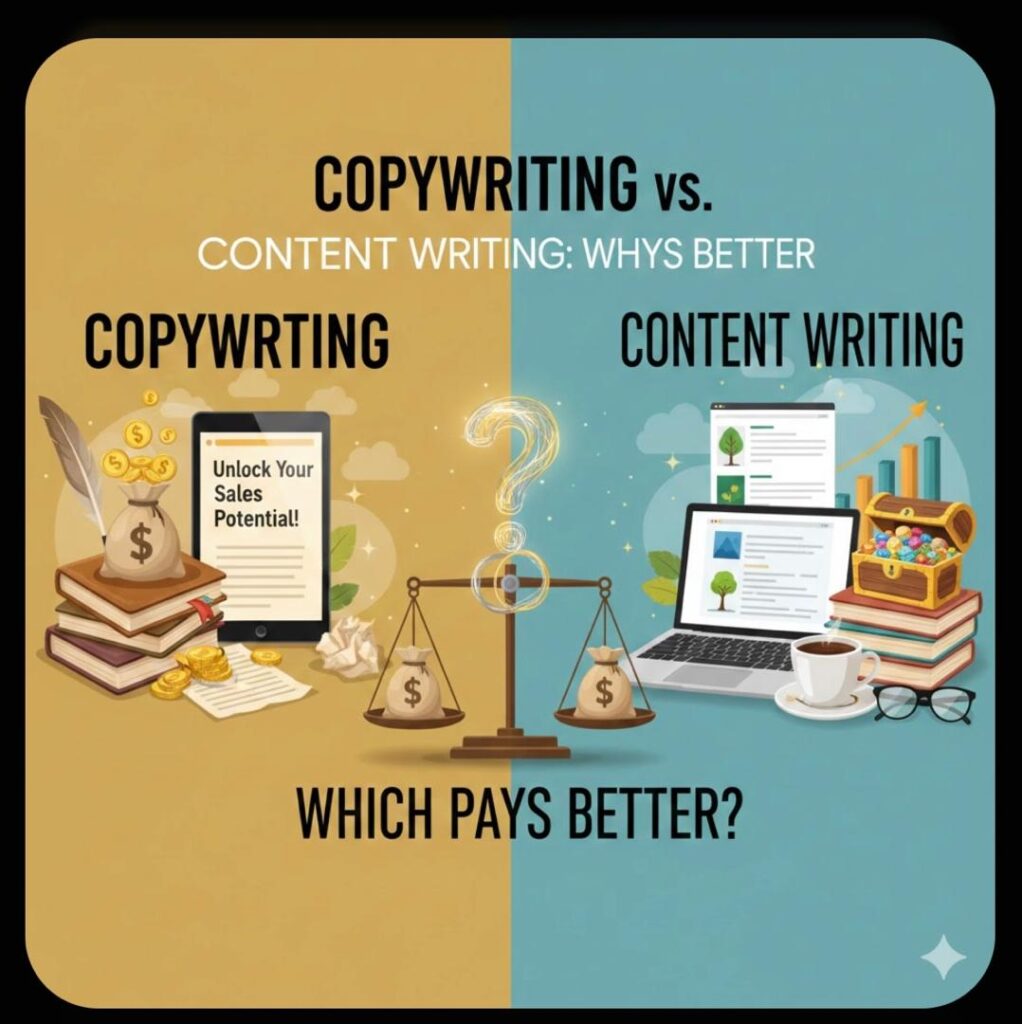
Let me be straight with you: I’ve had this conversation at least a hundred times with aspiring writers sliding into my DMs, asking the golden question—”Should I do copywriting or content writing? Which one actually makes money?”
And honestly? It’s like asking whether a surgeon or a general practitioner makes more money. The answer is frustratingly nuanced, maddeningly dependent on about seventeen different variables, and—here’s the kicker—both can make you either very comfortable or perpetually broke, depending on how you play your cards.
So let’s cut through the BS and talk real numbers, real opportunities, and what actually determines your paycheck in 2025.
What’s the Actual Difference Between Copywriting and Content Writing?
Before we dive into the money talk—because I know that’s why you’re here—let’s get our definitions straight. Too many writers blur these lines, and that confusion directly impacts their earning potential.
Copywriting is persuasion with a deadline. It’s writing that sells. Whether you’re crafting a product description that makes someone click “Add to Cart” at 2 AM or developing an email sequence that converts cold leads into paying customers, copywriting has one job: drive action. It’s short, punchy, conversion-focused, and often backed by serious marketing budgets.
Content writing, on the other hand, is the long game. You’re building trust, educating audiences, establishing authority, and nurturing relationships. Think blog posts, articles, whitepapers, case studies—content that positions a brand as the go-to expert in their field. It’s less about the immediate sale and more about the slow burn that eventually turns readers into loyal customers.
Here’s where it gets interesting: copywriters get paid for results. Content writers get paid for volume and consistency. And that fundamental difference shapes everything about compensation in these fields.
Which Writing Job Pays More: Copywriting or Content Writing?
Alright, let’s talk numbers—but I’m warning you, the answer isn’t as clean as you’d like.
The Short Answer: Copywriting generally pays more per project, but content writing can generate more stable, predictable income.
The Real Answer: It depends on your niche, experience level, client base, and how well you sell your services.
According to 2025 market data, freelance copywriters charge anywhere from $50 to $300+ per hour, while content writers typically fall in the $30 to $150 per hour range. But—and this is crucial—those ranges are massive because they encompass everything from beginners scrambling for Upwork gigs to seasoned professionals with Fortune 500 retainers.
Let me break down the typical earning trajectories:
| Experience Level | Copywriting Annual Income | Content Writing Annual Income |
|---|---|---|
| Entry Level (0-2 years) | $35,000 – $50,000 | $30,000 – $45,000 |
| Mid-Level (3-5 years) | $60,000 – $90,000 | $50,000 – $70,000 |
| Senior Level (6-10 years) | $90,000 – $150,000+ | $70,000 – $100,000 |
| Top Tier (10+ years) | $150,000 – $300,000+ | $100,000 – $150,000 |
[Insert image of professional writer at desk with laptop showing earnings dashboard]
Notice how copywriting’s ceiling is significantly higher? That’s because when you’re writing sales pages that generate millions in revenue, clients don’t blink at five-figure project fees. But content writing offers something copywriting sometimes doesn’t: volume-based stability.
How Do Copywriting and Content Writing Differ in Terms of Purpose?
This isn’t just semantic hair-splitting—understanding the purpose behind each discipline directly impacts your earning potential.
Copywriting exists to convert. Every word is measured against a conversion metric. Did it get the click? Did it generate the lead? Did it close the sale? The ROI is trackable, measurable, and directly tied to revenue. This is why businesses pay premium rates for skilled copywriters—because they’re not buying words, they’re buying results.
I once wrote a landing page for a SaaS company that took me about six hours. They paid me $5,000. Why? Because that page generated $400,000 in annual recurring revenue. The math isn’t about hours—it’s about value delivered.
Content writing, conversely, plays the long game. Its purpose is to build authority, improve SEO rankings, nurture leads through the funnel, and establish thought leadership. The ROI is harder to track immediately, but its compound effect over time is undeniable. A well-optimized blog post might generate organic traffic and leads for years.
What Skills Are Needed for a Successful Copywriter Versus a Content Writer?
Here’s where things get practical. The skill sets overlap but have distinct emphases:
Copywriting Skills:
-
- Deep understanding of consumer psychology and decision-making triggers
-
- Ability to write compelling headlines that stop scrolls
-
- Mastery of persuasive frameworks (AIDA, PAS, Before-After-Bridge)
-
- A/B testing mindset and data interpretation
-
- Understanding of sales funnels and conversion optimization
-
- Ability to write in multiple formats (ads, emails, landing pages, video scripts)
Content Writing Skills:
-
- Strong research abilities and fact-checking discipline
-
- SEO knowledge and keyword optimization
-
- Long-form storytelling and narrative structure
-
- Subject matter expertise or ability to quickly develop it
-
- Consistent brand voice maintenance across hundreds of pieces
-
- Content strategy and editorial calendar planning
[Insert image comparing skill sets with a Venn diagram showing overlap]
The highest earners in both fields? They master both skill sets. Because here’s the truth nobody tells you: the lines are blurring. Modern copywriters need SEO knowledge. Modern content writers need conversion awareness. The more you can do, the more you’re worth.
Can One Person Do Both Copywriting and Content Writing?
Absolutely—and honestly, you probably should.
I started as a content writer, churning out blog posts for $50 a pop, thinking that was the game. Then I learned copywriting and started charging $500 for email sequences. Same time investment, 10x the pay. But here’s what surprised me: becoming a better copywriter made me a better content writer. Understanding conversion psychology made my blog posts more engaging and actionable.
The writers making serious money in 2025 aren’t pigeonholing themselves. They’re offering comprehensive content packages: blog posts that nurture leads, landing pages that convert them, email sequences that close them, and social media copy that keeps them engaged.
This hybrid approach is particularly valuable for retainer clients. You become their entire content engine, which means predictable monthly income instead of the feast-or-famine freelance cycle.
What Are the Best-Paying Niches in Copywriting?
Not all copywriting gigs are created equal. If you want the big bucks, you need to write for industries with big budgets and high customer lifetime values.
Top-Paying Copywriting Niches in 2025:
-
- SaaS and B2B Technology – Companies spend massive budgets on customer acquisition; copywriters who understand complex products can command $150-$500 per hour
-
- Finance and Investment – High-trust copywriting for banking, investing, insurance; rates of $200-$400 per hour are common for experienced writers
-
- Health and Wellness – Supplement brands, fitness programs, medical devices; ethical writers can earn $100-$300 per hour
-
- E-commerce and Direct Response – Email sequences and sales pages for high-ticket products; often paid on performance bonuses
-
- Real Estate – Property descriptions, sales materials, investor presentations; $75-$250 per hour
The pattern? High-value transactions need high-quality copy. A mediocre sales page for a $2,000 course could cost the business hundreds of thousands in lost revenue. They’ll pay $10,000 for the right copywriter without hesitation.
[image showing industry comparison chart with average project rates]
How Does SEO Affect Pay in Content Writing?
Here’s the thing about content writing that most beginners miss: SEO skills can double your rates overnight.
A content writer without SEO knowledge might charge $50-$100 per blog post. A content writer who can demonstrate ranking success, keyword strategy, and organic traffic growth? They’re charging $200-$500 per post, minimum.
Why? Because SEO content writing directly impacts a client’s visibility, traffic, and ultimately, revenue. When you can show that your articles consistently rank on Google’s first page and drive qualified leads, you’re no longer selling words—you’re selling business growth.
The most successful SEO content writers in 2025 understand:
-
- Keyword research and search intent
-
- On-page optimization techniques
-
- Content gap analysis
-
- Competitor content analysis
-
- Performance tracking and iteration
I have a friend who niched down to SEO content for dental practices. She charges $800 per optimized blog post because she can demonstrate that her content generates patient bookings. That’s the power of tying your writing directly to business outcomes.
What Are Typical Freelance Rates for Copywriters and Content Writers?
Let’s get granular with the numbers, because “it depends” doesn’t pay your rent.
Freelance Copywriting Rates:
-
- Per Hour: $50-$300+
-
- Per Project: $500-$10,000+ (depending on complexity)
-
- Email Sequence (5-7 emails): $1,500-$5,000
-
- Landing Page: $1,000-$8,000
-
- Sales Page: $2,500-$15,000+
-
- Ad Copy (multiple variations): $500-$2,500
-
- Monthly Retainer: $3,000-$20,000+
Freelance Content Writing Rates:
-
- Per Hour: $30-$150
-
- Per Word: $0.10-$1.00+ (yes, some writers charge $1 per word)
-
- Blog Post (1,000-1,500 words): $150-$600
-
- Long-Form Article (2,000+ words): $400-$1,500
-
- White Paper: $2,000-$8,000
-
- Case Study: $800-$3,000
-
- Monthly Retainer (4-8 posts): $2,000-$10,000+
[Insert image showing rate comparison table]
The writers at the top of these ranges? They’ve built strong portfolios, specialized in profitable niches, and learned to sell value rather than time.
How Can Writers Increase Their Earnings in These Fields?
Okay, this is where most articles give you fluffy advice like “improve your craft” or “network more.” Sure, those help. But let me give you the actual strategies that moved my income from $40K to six figures:
1. Specialize ruthlessly. “I write about everything” means you’re competing with everyone. “I write SaaS email sequences for customer onboarding” means you’re one of maybe 50 people who can credibly make that claim. Guess who gets paid more?
2. Build a results-based portfolio. Don’t just show pretty words. Show outcomes. “This landing page generated 47% conversion rate” or “This blog post ranks #1 for [keyword] and drives 500 monthly visitors” tells potential clients exactly what they’re buying.
3. Learn to sell yourself. The uncomfortable truth: your writing ability might only account for 40% of your income potential. The other 60%? Sales, marketing, and relationship-building. The best writer who can’t find clients earns nothing.
4. Package your services strategically. Stop selling individual blog posts. Sell content strategies. Sell quarterly campaigns. Sell outcomes. A $500 blog post becomes a $5,000 content marketing package when positioned correctly.
5. Raise your rates regularly. If you’re not losing at least 20% of your pitches because of price, you’re undercharging. Every six months, increase your rates by 15-25% for new clients.
6. Add high-value services. Strategy consulting, content audits, conversion optimization—these command premium rates because they directly impact business performance.
Which Is Better for Long-Term Career Growth: Copywriting or Content Writing?
After 12 years in this industry, here’s my honest take: the future belongs to hybrid writers who can do both, but if I had to choose one foundation to build on, I’d start with copywriting.
Why? Because copywriting teaches you the fundamentals of persuasion, psychology, and what actually drives human behavior. Those skills transfer to everything—content writing, video scripts, podcast outlines, social media, product descriptions, you name it. A copywriter can easily pivot to content writing. A content writer transitioning to copywriting needs to learn an entirely new discipline.
That said, content writing offers more consistent work and potentially better work-life balance. If you’re creating 8-10 optimized blog posts monthly for three retainer clients, you’ve got predictable income without the high-stakes pressure of conversion-focused copywriting.
The smartest career path? Build copywriting skills first for the earning potential and persuasion fundamentals. Then expand into content writing for stability and scaling. Position yourself as a full-funnel content strategist who can handle awareness (content) and conversion (copy). That’s where the real money lives.
[image of career progression roadmap showing skills development over time]
The Real Talk: Market Trends and Demand in 2025
Let’s zoom out for a second. What’s actually happening in the market right now?
Both copywriting and content writing are experiencing unprecedented demand, but for different reasons. AI tools like ChatGPT have flooded the market with mediocre content, which means businesses are willing to pay serious premiums for human writers who can deliver nuance, strategy, and originality.
The copywriting market is particularly hot because conversion rates directly impact revenue. As acquisition costs rise across digital channels, businesses need copy that works harder. A 2% improvement in conversion rate on a million-dollar product launch? That’s $20,000 in value. Suddenly that $5,000 copywriting fee looks like a bargain.
Content writing demand remains strong, but it’s bifurcating. Bottom-tier content farms are dying as AI commoditizes generic articles. But strategic content that requires expertise, original research, and sophisticated SEO understanding? That’s more valuable than ever.
The writers getting left behind? Generalists offering commodity services. The writers thriving? Specialists offering strategic, results-driven work that AI can’t replicate.
Tools That Actually Help You Earn More
Look, I’m not going to bore you with 20 tool recommendations because you clicked an affiliate link. But there are a handful of platforms that legitimately help you work faster and charge more:
For copywriting, tools like Jasper AI and Copy.ai aren’t replacements for your skills—they’re accelerators. Use them for initial drafts and variations, then apply your human expertise to refine and strategize. This lets you take on more projects without sacrificing quality.
For content writing, SurferSEO and Clearscope are game-changers if you’re doing SEO work. They provide data-driven optimization recommendations that help you demonstrate value to clients. When you can show exactly why your content will outrank competitors, pricing conversations get much easier.
Grammarly Premium and ProWritingAid aren’t sexy, but they catch errors that could cost you clients. Professional polish matters.
Honestly though? The best tool is a strong portfolio and the confidence to charge what you’re worth. Everything else is just support infrastructure.
My Final Take: Which Should You Choose?
If you want the highest earning potential and don’t mind higher pressure: Copywriting.
If you want more stable income and enjoy deep-dive research: Content writing.
If you want to actually maximize your career: Both.
The writers making $200K+ aren’t choosing sides—they’re mastering the full spectrum and positioning themselves as strategic partners who can handle every stage of the content journey.
Start with whichever feels more natural to your current skills, but plan to expand. Spend six months getting really good at one, then spend the next six months adding the other to your toolkit. By year two, you’re not just a copywriter or content writer—you’re a content strategist who can command premium rates and pick your clients.
And remember: your income in this field isn’t determined by your writing ability alone. It’s determined by your ability to find great clients, sell your value effectively, deliver measurable results, and continuously level up your skills.
The good news? Both paths can get you where you want to go. The even better news? You don’t actually have to choose just one.
So, what’s your move? Are you going all-in on conversion-focused copywriting, building a content empire, or taking the hybrid approach? Drop a comment below—I’d love to hear where you’re at in your writing journey and what’s working for you in 2025.
call-to-action image encouraging reader engagement and newsletter signup